How ITASC works
ITASC takes a time-lapse of a cell monolayer and returns, for every cell, an outline and an identity that hold across the whole recording: its shape in each frame, and the fact that it is the same cell from the first frame to the last. From that it measures which cells touch and when neighbors swap. This page states the problem and the idea behind the solution; the later pages detail each step and build on it.
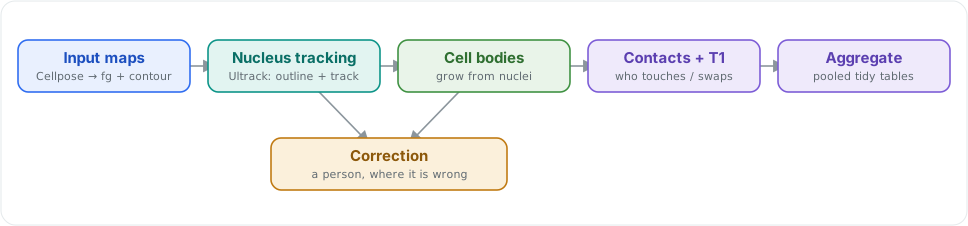
The pipeline end to end: the input maps feed nucleus tracking, each cell body grows from its tracked nucleus, and the contacts and pooled tables follow. Correction sits on the two segmentation-and-tracking stages, where a person fixes what the automatics miss.
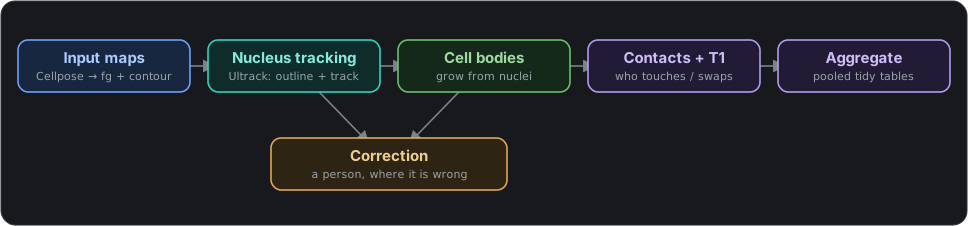
The pipeline end to end: the input maps feed nucleus tracking, each cell body grows from its tracked nucleus, and the contacts and pooled tables follow. Correction sits on the two segmentation-and-tracking stages, where a person fixes what the automatics miss.
The problem
The monolayers ITASC is built for are dense and highly motile. Cells are packed with no clear gap between them, and they travel far between frames, sliding past one another and trading neighbors. Two jobs have to be done on this, and they interfere.
Segmentation draws each cell’s outline in each frame. Where two cells touch, the boundary between them is uncertain.
Tracking matches each cell to itself in the next frame. When cells move far and look alike, the match is uncertain as well.
The usual pipeline does the two in order: outline every frame, then link the outlines into tracks. It fails because the outlines are never exactly right, and they are wrong in different ways from frame to frame. Two touching cells read as one shape in one frame and two in the next, so the linker has nothing consistent to match and the track breaks. On a dense, moving sheet this happens in every frame, and the errors compound.
Segmentation and tracking together
ITASC tracks with Ultrack, which does not commit to one outline per frame. For each frame it builds many candidate outlines: it over-segments the image into small fragments, then lets them merge in nested ways, so a cell can be a single fragment, a pair, or a larger clump. It then selects, across all frames at once, the set of outlines and links that is most consistent in time, subject to constraints derived from biology: cells move only a short distance between frames, may divide into two but not merge, and may not share a pixel. Because the outline and the track are scored in a single calculation, the selected outline is also the one that tracks correctly. The correct split of two touching cells is recovered because only that split follows cleanly through time.
Two consequences
Nuclei first. Nuclei are compact and come apart more cleanly than cell bodies, so ITASC tracks the nuclei first, then grows each cell body outward from its tracked nucleus. The body takes the nucleus’s identity, so a nucleus and its cell stay in step across the recording.
A person at the end. No solver is perfect on dense, dividing cells, and one wrong track spoils every measurement built on it. So each automatic result is handed to a person to correct, with the candidate outlines Ultrack already built offered as selectable alternatives.
The parts
Preparing the input maps. Turn the raw images into the two maps Ultrack needs: where the cells are, and where their boundaries lie.
Outlining and tracking the nuclei. Build the candidates, solve for the consistent set, correct it.
Growing the cell bodies. Extend each cell out from its tracked nucleus.
Measuring the result. Cell shapes, neighbors, and the moments two cells swap neighbors.